
Family guide · Phonics
Phonics for preschoolers: a simple order to follow at home
Phonics starts long before reading: with hearing that cat and hat rhyme, clapping the parts of a word and noticing that sun and sock start the same way. Here is an order that works for ages 3 to 5, a game for each step and what to expect by age.
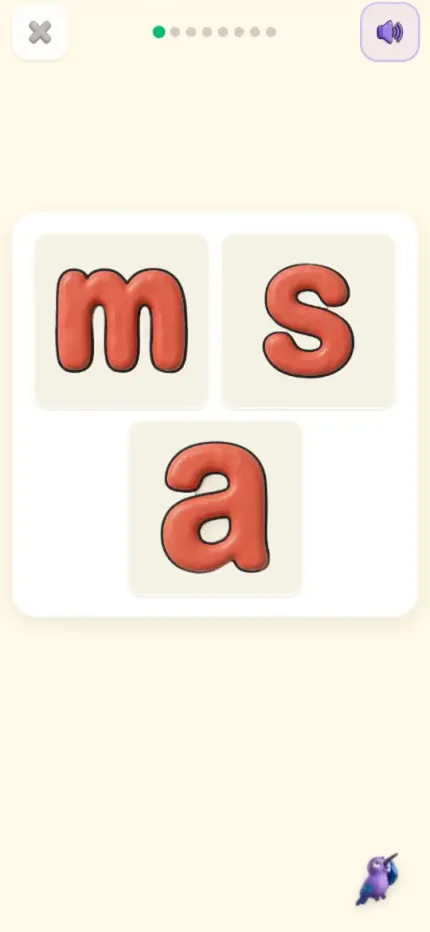
Something to try
Say the sound, not the letter name
When you play with letters, say “sss” for s and “mmm” for m, not “ess” and “em”. Keep stop sounds short: “b”, not “buh”. Start with sounds you can stretch, like s, m, f and l: they are easier to hear.
Section 01
Big parts first, single sounds later
The What Works Clearinghouse practice guide on foundational reading skills recommends an order: words, then syllables, then the first sound and the rest of a word, then single sounds. It also suggests starting with a few consonants and short vowels, such as /s/, /m/, /d/, /p/ and /a/, instead of the whole alphabet at once.
Section 02
Age 3: rhymes and first sounds, with help
The Head Start Early Learning Outcomes Framework places hearing rhymes and noticing words that start the same way, with an adult’s help, between 36 and 48 months. Read rhyming books and pause before the rhyming word so your child can fill it in. Ask “Which one starts like sun: sock or hat?”
Section 03
Age 4: syllables and sorting by sound
Between 48 and 60 months, the same framework adds counting the syllables in a word. Clap names at dinner (“Al-ex-an-der” is four claps) and sort toys into two baskets by their first sound. You can also try joining a first sound to the rest of a word: “c… at” makes cat.
Section 04
Age 5: letter sounds and short words
By 60 months, the framework describes children beginning to say the first sound of a word and knowing the sounds of several letters. By the end of kindergarten, the Common Core standards for foundational reading skills expect children to blend the sounds of short words like sun: /s/ /u/ /n/. It is fine if your 5-year-old is still working on first sounds.
Section 05
If your child also speaks Spanish
Spanish vowels almost always keep the same sound, while an English vowel can sound several ways: the a in apple is not the a in cake. English also has sounds Spanish does not, like the short i in pig. Mixing the two is normal; play with one language at a time.
Section 06
Phonics in Ziippi
In a profile set to English, the Letters area has sound activities written for English: rhymes, first sounds, syllables, the sound each letter makes and joining sounds into a word. Your child hears “sss… sun” and taps the s. These activities are for ages 3 and up.
In English, your child practices numbers, letters, colors and shapes, tracing and feelings, and in Speak learns first words in Spanish. In a profile set to Spanish, the spoken instructions are in Spanish and are not translated.
Frequently asked questions
When should phonics start?
With play, from about 3: rhymes and first sounds. The Head Start framework places knowing several letter sounds closer to 5.
Letter names or letter sounds first?
For these games, sounds: say “sss”, not “ess”. Your child can learn the names too; the sound is what helps when joining sounds into words.
My child mixes English and Spanish sounds. Is that a problem?
Mixing languages is normal for children growing up with two, according to the AAP and ASHA parent guide on HealthyChildren.org. Play with one language at a time.
How does the subscription work?
It is bought through the App Store or Google Play. Eligible accounts get a trial when they confirm in the store; then the plan is charged and renews automatically unless you cancel in the store before the renewal date.
Try an activity with Ziippi
Explore an activity and see how you can help your child.
Try an activityPrefer the app? Find it in your store.